

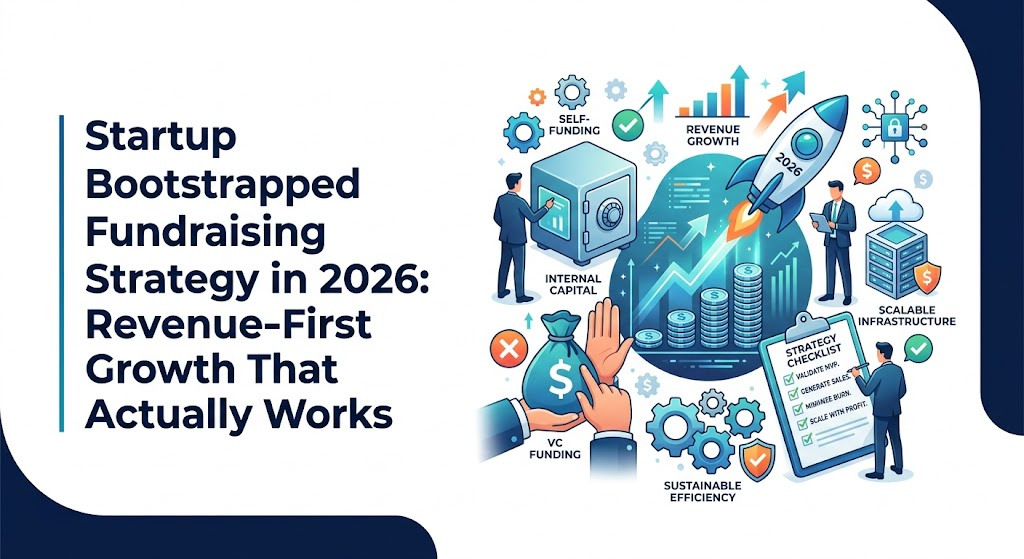

In 2026, the startup world has shifted decisively toward sustainable, revenue-driven models. With tighter venture capital markets, longer fundraising cycles, and higher investor scrutiny, many founders are embracing a startup bootstrapped fundraising strategy — building real traction with customer dollars before seeking external capital, if they seek it at all.
This approach prioritizes cash flow, customer validation, and disciplined execution over rapid spending and hype. Founders who bootstrap early often reach profitability faster, retain more ownership, and enter any future funding round from a position of strength. Whether you’re a solo founder launching a SaaS tool or a small team scaling a service business, this strategy offers flexibility and resilience in an uncertain economic environment.
This guide explores what a bootstrapped fundraising strategy looks like today, its core principles, proven tactics, real-world success stories, potential pitfalls, and a clear decision framework for when to stay bootstrapped versus raising funds.
What Is a Startup Bootstrapped Fundraising Strategy?
A startup bootstrapped fundraising strategy means funding early growth primarily through personal savings, revenue from initial customers, and operational discipline — rather than relying on angel investors or venture capital from day one.
Instead of pitching for pre-product-market fit (PMF) capital, founders focus on generating paying customers quickly, reinvesting profits, and proving the business model organically. Only after achieving strong traction (such as consistent revenue, healthy unit economics, or repeatable sales) do they consider external funding — and even then, on far better terms.
Key characteristics include:
- Revenue as the primary fuel for growth
- Minimal or no equity dilution in the early stages
- Emphasis on profitability and cash-flow positivity
- Lean operations with a focus on capital efficiency
This contrasts with the traditional “raise first, build later” model that dominated the low-interest-rate era. In 2026, bootstrapping (or a hybrid version) has become a deliberate choice for many, not just a necessity.
Why Bootstrapping Is Gaining Momentum in 2026
Several market realities make bootstrapped strategies more attractive:
- Selective Capital Environment: Venture funding remains available but is more concentrated. Investors demand proven traction, clear paths to profitability, and realistic growth projections.
- Higher Survival Rates: Bootstrapped companies often show stronger five-year survival statistics and faster paths to profitability compared to many VC-backed peers.
- Founder Control: Retaining 70-80%+ ownership at exit is far more common when you bootstrap initially.
- Better Negotiation Power: Entering a raise with revenue, customers, and positive cash flow allows founders to dictate terms rather than accept whatever is offered.
Many successful companies in 2026 use a hybrid model: bootstrap to validate and reach early revenue milestones, then raise strategically to accelerate scaling without desperation.
Core Principles of an Effective Bootstrapped Fundraising Strategy
Successful bootstrapped startups follow these foundational rules:
- Revenue-First Mindset — Treat every sale as validation and funding. Prioritize products or services that can generate income quickly, even if imperfect.
- Capital Discipline — Ruthlessly cut non-essential costs. Focus spending on activities that directly drive revenue or retention.
- Customer-Funded Growth — Use pre-sales, subscriptions, or service retainers to fund development rather than personal runway alone.
- Lean Validation — Build minimum lovable products (MLPs) and iterate based on real paying user feedback.
- Sustainable Scaling — Grow at a pace your cash flow supports, avoiding over-hiring or premature expansion.
These principles enforce focus and creativity that often lead to more robust businesses.
Step-by-Step Playbook: Implementing Your Bootstrapped Strategy
Follow this phased approach to maximize your chances of success:
Phase 1: Foundation (Months 1–3)
- Validate your idea with low-cost experiments or a landing page.
- Use personal savings or side income for initial development.
- Secure your first 5–10 paying customers through direct outreach, content marketing, or partnerships.
Phase 2: Early Traction (Months 4–12)
- Refine your offering based on customer input.
- Aim for positive cash flow or break-even.
- Implement repeatable sales processes and track key metrics like customer acquisition cost (CAC), lifetime value (LTV), and churn.
Phase 3: Sustainable Growth (Year 2+)
- Reinvest profits into marketing, product improvements, or team expansion.
- Build operational systems that scale without massive capital.
- Monitor unit economics closely to ensure every new customer adds value.
Phase 4: Strategic Funding Decision (When Ready)
- Only raise if external capital clearly accelerates a proven model (e.g., entering new markets or heavy R&D).
- Use traction to negotiate higher valuations and founder-friendly terms.
Throughout, maintain detailed financial tracking and regularly review your runway.
Proven Tactics for Bootstrapped Revenue Generation
Practical methods that work in 2026 include:
- Service-to-Product Transition — Start with consulting or custom services in your niche to generate cash while building a standardized SaaS or product.
- Pre-Sales and Crowdfunding — Use platforms for non-dilutive capital through early commitments.
- Partnerships and White-Labeling — Leverage existing networks for distribution without heavy marketing spend.
- Content and Community-Led Growth — Organic channels like SEO, newsletters, and forums can drive low-cost acquisition.
- Revenue-Based Financing (RBF) — Once you have revenue, consider non-dilutive options that repay as a percentage of sales.
Focus on high-margin offerings and recurring revenue models whenever possible to create predictable cash flow.
Real-World Success Stories of Bootstrapped Startups
Classic and modern examples demonstrate the power of this approach:
- Mailchimp — Bootstrapped for years while growing to hundreds of millions in revenue through organic customer growth before any major external moves.
- Basecamp — Maintained profitability and independence with a deliberate slow-growth philosophy, focusing on product quality over hype.
- ServiceNow — Early bootstrapping phase with initial paying customers provided strong validation before raising capital on favorable terms, eventually leading to massive scale.
- Zoho — Built a comprehensive suite of business tools largely through reinvested profits, remaining largely independent.
Many 2026 founders follow a similar path: bootstrap to $100K–$1M+ ARR, prove the model, then optionally raise to fuel hyper-growth.
Advantages and Challenges of Bootstrapping
Key Advantages:
- Full ownership and decision-making control
- Stronger focus on real customer problems
- Faster path to profitability and resilience
- Better long-term wealth creation for founders
Common Challenges:
- Limited resources can slow hiring or marketing
- Personal financial risk during early stages
- Potential opportunity cost if competitors raise and scale faster
- Emotional strain from wearing multiple hats
Many founders mitigate risks by starting part-time or maintaining a day job initially while validating demand.
When Should You Consider Raising Capital After Bootstrapping?
Not every company needs to stay fully bootstrapped forever. Strong signals to explore funding include:
- Proven product-market fit with repeatable sales
- Healthy unit economics (LTV significantly higher than CAC)
- Clear use of capital that accelerates growth (e.g., team expansion, market entry)
- Market window requiring speed to capture share
If these aren’t present, continuing to bootstrap often yields better outcomes. Use a simple decision matrix: score your traction, runway, market dynamics, and personal goals before deciding.
Hybrid Strategies: Bootstrap First, Raise Strategically
In 2026, the smartest path for many is hybrid: bootstrap aggressively to de-risk the business, then raise smaller, targeted rounds on strong terms. This combines the discipline of bootstrapping with the acceleration potential of capital when it makes sense.
Venture debt, revenue-based financing, or angel rounds from aligned investors can bridge gaps without heavy dilution.
Common Pitfalls to Avoid in Your Bootstrapped Journey
- Underestimating the time and personal toll of wearing all hats
- Scaling too quickly before systems are in place
- Ignoring financial metrics until cash runs low
- Failing to build a network or community for support and acquisition
- Comparing your journey only to flashy VC-funded stories on social media
Regular check-ins with mentors, advisors, or fellow bootstrapped founders can help maintain perspective.
Tools and Resources for Bootstrapped Founders in 2026
Leverage affordable or free tools for operations, marketing, and finance:
- No-code platforms for rapid prototyping
- Open-source or freemium analytics and CRM solutions
- Community forums and bootstrapped founder networks for advice
- Basic accounting software to track every dollar
Focus on capital-efficient infrastructure and automation to stretch your resources further.
Frequently Asked Questions
What does bootstrapped mean for a startup?
It means self-funding through personal resources and early revenue rather than external investors, allowing greater control and focus on sustainable growth.
Can bootstrapped startups still raise funding later?
Absolutely. Many do so on better terms after proving traction, with stronger valuations and less dilution.
Is bootstrapping better than raising VC in 2026?
It depends on your goals, market, and risk tolerance. Bootstrapping excels for control and profitability; VC suits capital-intensive, winner-take-all opportunities.
How long can a startup realistically bootstrap?
It varies widely. Some reach significant scale over years; others transition to hybrid funding within 12–24 months once metrics justify it.
What are the biggest risks of bootstrapping?
Running out of personal runway, slower growth against funded competitors, and founder burnout from resource constraints.
Do investors prefer bootstrapped startups?
Many do, especially when the company shows proven revenue, efficient growth, and disciplined execution — it de-risks the investment.
Conclusion: Building a Resilient Startup on Your Own Terms
A well-executed startup bootstrapped fundraising strategy in 2026 empowers founders to create durable businesses rooted in real value rather than hype. By prioritizing revenue, customer validation, and disciplined growth, you build stronger fundamentals and retain the freedom to chart your own path.
Whether you remain fully bootstrapped or eventually raise capital strategically, the habits developed during the bootstrap phase — focus, creativity, and financial prudence — become lasting competitive advantages.
In an era where execution quality matters more than fundraising velocity, bootstrapping isn’t settling for less. It’s often the smartest way to build something that lasts. Start with your first paying customer, track every metric rigorously, and let real traction guide your next moves.
The most successful founders in this environment treat capital as a tool, not a requirement. Build something customers love and pay for — the rest tends to follow.
