

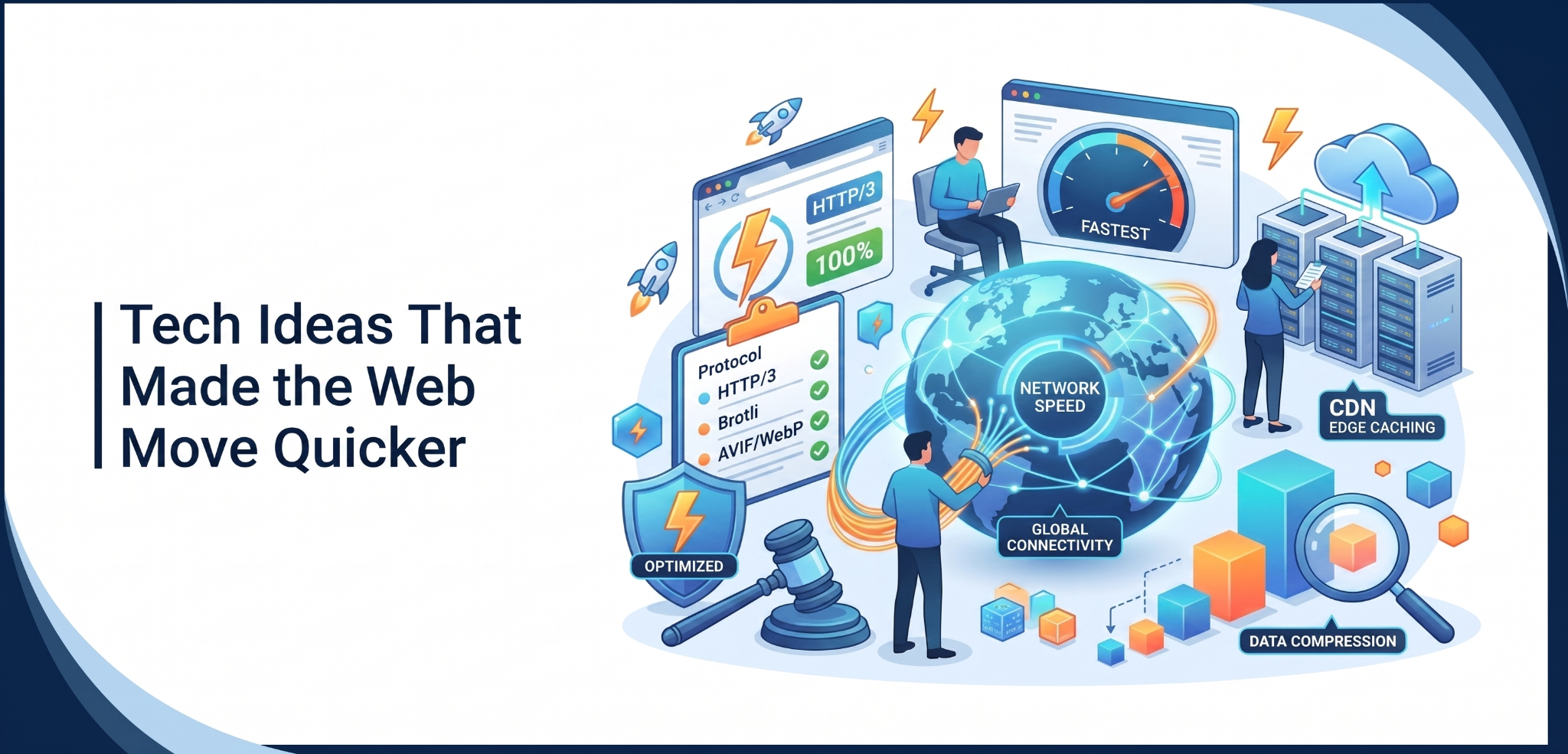

In our hyper-connected digital age, every millisecond shapes user decisions. Visitors abandon slow sites in seconds, and businesses lose real revenue when pages lag. That’s exactly why the most impactful tech ideas that made the web move quicker have transformed online experiences from frustrating waits into seamless, instant interactions.
These breakthroughs—spanning smarter protocols, intelligent data delivery, and automated optimizations—haven’t just trimmed a few seconds; they’ve fundamentally rewritten how the internet delivers content. Today, the average web page loads far faster than it did even five years ago, despite richer media and more dynamic features. Implementing these advancements can slash load times by 30-50% or more, directly boosting engagement, conversions, and search visibility.
This comprehensive guide explores the key tech ideas that made the web move quicker, drawing on verified benchmarks and real-world results from 2025–2026 studies. Whether you run an e-commerce store, a content platform, or a corporate site, you’ll discover practical insights to apply these innovations immediately. We’ll cover everything from foundational protocol upgrades to cutting-edge AI tools, all while keeping user experience front and center.
Why Web Speed Matters More Than Ever in 2026
Page speed has evolved from a nice-to-have into a core business imperative. Google’s own data and industry reports confirm that even a one-second delay in page load time can reduce conversions by approximately 7%. On mobile devices, where over half of global traffic originates, the stakes are even higher—users on spotty networks expect sub-two-second experiences or they bounce.
Beyond direct revenue impact, speed influences SEO rankings through Core Web Vitals. Sites meeting Google’s thresholds for loading performance, interactivity, and visual stability consistently see better organic visibility. In 2026, the benchmark for a “good” Largest Contentful Paint (LCP) sits under 2.0 seconds, with Interaction to Next Paint (INP) needing to stay below 150 milliseconds.
These expectations stem from real user behavior: 53% of mobile visitors abandon pages that take more than three seconds to load. The tech ideas that made the web move quicker address this impatience head-on by minimizing data travel, shrinking payloads, and enabling smarter processing closer to the end user.
The Evolution of Web Protocols – From HTTP/1.1 to HTTP/3
Early web protocols created unnecessary bottlenecks. Modern upgrades have eliminated many of those limitations at the transport layer.
Multiplexing Magic in HTTP/2
Introduced in 2015, HTTP/2 brought multiplexing, allowing multiple requests and responses over a single connection at once. It also added header compression and server push features. Benchmarks on real-world sites show page load times dropping noticeably—often by double-digit percentages—thanks to fewer round trips and reduced overhead compared to HTTP/1.1’s sequential processing.
This single change made parallel resource loading standard, setting the stage for even bigger gains.
QUIC and the Leap to HTTP/3
HTTP/3, built on Google’s QUIC protocol, further refines performance by using UDP instead of TCP. It eliminates head-of-line blocking and speeds up connection handshakes dramatically. Large-scale tests by Wix across millions of sites revealed up to 33% faster connection setup times and 20% better LCP scores at the 75th percentile. Akamai’s 2025 reports confirm around 30% latency reduction on mobile networks, especially under packet loss or high-latency conditions.
By 2025–2026, HTTP/3 adoption reached about 35% globally, proving its value for everyday browsing. These protocol innovations remain among the most foundational tech ideas that made the web move quicker.
Content Delivery Networks – Bringing Data Closer to Users
Physical distance between servers and visitors creates unavoidable latency. Content Delivery Networks (CDNs) solve this by caching static and dynamic assets on edge servers worldwide.
A request now travels to the nearest PoP (point of presence) instead of crossing oceans to your origin server. High cache-hit ratios offload 30–70% of traffic, slashing costs while delivering content in milliseconds. Providers like Cloudflare and Akamai have democratized access, making global performance achievable even for smaller sites. This geographic intelligence is a cornerstone of modern web speed.
Advanced Compression Techniques That Shrink Data Without Compromise
Smaller files equal faster delivery. Compression has advanced far beyond basic methods.
Brotli: The Superior Successor to Gzip
Brotli, released by Google in 2015, consistently outperforms Gzip. Independent benchmarks show Brotli delivering 15–30% better compression ratios overall, with specific gains of 21% on HTML, 14% on JavaScript, and 17% on CSS. In practical tests, a 500KB JavaScript bundle might shrink to 135KB with Gzip but only 112KB with Brotli—an extra 17% saving that compounds across every resource.
These reductions directly improve Time to Interactive without any quality loss, making Brotli one of the highest-ROI tech ideas that made the web move quicker.
Next-Gen Image Formats Revolutionizing Visual Delivery
Images often comprise over 50% of a page’s total weight. Legacy formats like JPEG and PNG no longer cut it.
WebP’s Efficient Compression Edge
WebP delivers 25–34% smaller file sizes than equivalent-quality JPEGs while supporting transparency and animation. Google’s own compression studies confirm these gains hold across thousands of real images.
AVIF – Pushing Boundaries Further
AVIF takes efficiency even higher, offering up to 50% smaller files than JPEG and 20–30% smaller than WebP at comparable visual quality. Modern browsers now support both formats natively, and automated conversion tools make implementation straightforward. Pairing them with responsive images and lazy loading creates massive bandwidth savings.
Smart Caching and Service Workers for Instant Reloads
Caching stores reusable assets locally or at the edge. Service Workers take this to the next level by enabling offline support and background updates in Progressive Web Apps (PWAs).
Intelligent cache headers ensure fresh content when needed while serving cached versions instantly on repeat visits. The result: sub-second reloads and dramatically reduced server load.
Progressive Web Apps – App-Like Speed on the Web
PWAs combine web reach with native-app performance. They load a cached shell instantly and update content seamlessly in the background. Case studies report 25–80% faster experiences, especially on unreliable networks, making PWAs a standout innovation for user retention.
JavaScript Optimizations and Modern Rendering Strategies
Heavy client-side JavaScript can block rendering. Techniques like code splitting, async/defer attributes, and server-side rendering minimize shipped code while keeping interactivity snappy. Frameworks now prioritize static generation where possible, shipping minimal JavaScript only when truly needed.
Edge Computing – Processing at the Brink of the Network
Edge functions run code on CDN servers near the user, eliminating origin round trips for dynamic content. This approach powers personalized experiences at global scale with near-zero added latency—one of the newest tech ideas that made the web move quicker.
AI and Machine Learning in Automated Performance Tuning
Machine learning now predicts traffic patterns, auto-optimizes images on the fly, and routes requests intelligently. Integrated into CDNs and hosting platforms, these tools deliver hands-off gains that improve over time.
Measuring and Monitoring with Core Web Vitals
Google’s Core Web Vitals—LCP, INP, and Cumulative Layout Shift (CLS)—provide the gold standard for real-user experience. In 2024–2025 data, sites achieving “good” thresholds saw measurable ranking and retention lifts. Tools like PageSpeed Insights and real-user monitoring dashboards make ongoing optimization straightforward.
Practical Implementation Steps for Immediate Gains
- Audit your current protocol and enable HTTP/3 where supported.
- Integrate a modern CDN with aggressive caching rules.
- Convert images to AVIF or WebP with proper fallbacks.
- Enable Brotli compression at the server or CDN level.
- Implement service workers and PWA features for key pages.
- Split and defer JavaScript bundles aggressively.
- Set up edge functions for dynamic personalization.
- Monitor Core Web Vitals weekly and iterate based on data.
Start with high-impact, low-effort changes. Many sites see 30–50% overall speed improvements within weeks.
Conclusion
The tech ideas that made the web move quicker represent more than incremental tweaks—they form a complete ecosystem of innovations that prioritize users above all else. From protocol revolutions and global CDNs to intelligent compression, next-gen images, and AI-driven automation, each advancement has collectively slashed load times while enriching what the web can deliver.
In 2026, speed is no longer optional. It’s a competitive advantage that drives higher conversions, better SEO rankings, and stronger user loyalty. By embracing these proven strategies, your site won’t just load faster—it will create delightful experiences that keep visitors coming back.
The tools and knowledge are readily available. The only question is how quickly you’ll implement them. Start today with a single audit or optimization, measure the results, and watch your web presence accelerate. The faster web isn’t coming—it’s already here, and the sites that adopt these ideas will lead the way.
