

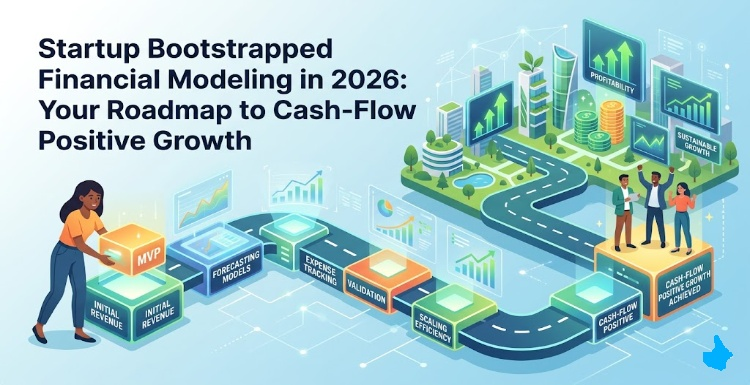

In today’s capital-selective environment, many founders choose to bootstrap their startups, relying on early revenue and disciplined spending instead of external funding. Startup bootstrapped financial modeling becomes the critical tool that keeps these ventures alive and thriving.
Unlike VC-backed models focused on hyper-growth and burn rate, bootstrapped financial models prioritize revenue-first forecasting, positive unit economics, extended cash runway, and break-even timelines. They help founders make data-driven decisions on pricing, hiring, marketing spend, and when (or if) to raise capital later.
This comprehensive guide shows you how to build, maintain, and use a robust financial model tailored for bootstrapped startups. Whether you’re launching a SaaS tool, e-commerce store, or service business, these practices will help you stretch limited resources, validate your business model, and build long-term resilience.
Why Bootstrapped Financial Modeling Differs from Traditional Startup Models
Traditional startup financial models often assume large funding rounds to fuel aggressive customer acquisition and market dominance. Bootstrapped models flip this script: they emphasize cash conservation, realistic revenue ramps, and profitability as early as possible.
Key differences in 2026:
- Focus on monthly recurring revenue (MRR) or service-based cash inflows rather than projected TAM/SAM capture.
- Conservative growth assumptions grounded in actual customer data instead of hockey-stick projections.
- Heavy emphasis on cash flow statements over vanity metrics.
- Scenario planning for “what if” situations like delayed payments or higher churn.
Founders who master this approach often achieve stronger unit economics and retain far more equity. Bootstrapping forces clarity: every expense must tie directly to revenue generation or essential operations.
Core Components of a Strong Bootstrapped Financial Model
A solid model includes three interconnected financial statements plus supporting schedules:
- Income Statement (P&L): Tracks revenue, cost of goods sold (COGS), gross margin, operating expenses, and net profit.
- Cash Flow Statement: Shows actual cash movements — critical for bootstrapped businesses where “profit on paper” doesn’t pay bills.
- Balance Sheet: Monitors assets, liabilities, and equity (often simpler in early bootstrapped stages).
- Supporting Schedules: Revenue drivers, headcount planning, expense breakdowns, and key metrics dashboard.
For bootstrapped startups, add a dedicated runway calculator and break-even analysis to monitor sustainability.
Step-by-Step: How to Build Your Bootstrapped Financial Model
Follow this practical process using Google Sheets or Excel (widely recommended for flexibility and low cost):
- Define Assumptions First Start with realistic inputs: pricing tiers, expected customer acquisition channels, conversion rates, churn, variable costs per sale, and fixed monthly expenses. Base early assumptions on market research, competitor benchmarks, or initial customer interviews. Update them monthly as real data arrives.
- Build Revenue Projections (Bottom-Up) Use a bottom-up approach for the first 12–24 months:
- Number of new customers per month × average revenue per customer (ARPU)
- Subtract churn and account for upsells/cross-sells For SaaS: Forecast MRR growth based on sign-ups, expansion, and retention. For e-commerce or services: Model units sold or billable hours.
- Map Out Cost Structure Separate fixed costs (rent, tools, salaries) from variable costs (payment processing fees, ad spend, COGS). In bootstrapped mode, keep fixed costs minimal — favor contractors or no-code tools over full-time hires initially.
- Create Cash Flow Projections Factor in payment terms: customers may pay net-30 or net-60, while vendors often demand upfront payment. Include one-time setup costs and seasonal variations.
- Calculate Key Metrics and Runway Track:
- Gross margin (aim for 60–80%+ in many digital businesses)
- Customer Acquisition Cost (CAC)
- Lifetime Value (LTV) — ideally LTV:CAC ratio > 3:1
- Burn rate and runway (months of cash left)
- Break-even point (when revenue covers all expenses)
- Add Scenario Planning Build best-case, base-case, and worst-case versions. Test impacts of higher churn, slower sales, or unexpected costs.
- Review and Iterate Monthly Compare actuals against projections. Adjust assumptions and spending accordingly.
Many founders start simple with a 12–36 month horizon and expand as the business matures.
Essential Metrics Every Bootstrapped Founder Must Track
Focus on these KPIs in your model dashboard:
- MRR/ARR: Core indicator of recurring revenue health.
- Churn Rate: High churn kills bootstrapped businesses quickly.
- LTV:CAC Ratio: Ensures marketing spend is efficient.
- Gross Margin: Shows product profitability after direct costs.
- Cash Runway: Target at least 6–12 months; extend it through revenue growth or cost cuts.
- Payback Period: How long to recover CAC from a new customer (aim for under 12 months).
Regular monitoring prevents small issues from becoming existential threats.
Tools and Templates for Bootstrapped Financial Modeling in 2026
You don’t need expensive software. Popular low-cost or free options include:
- Google Sheets or Excel: Free, customizable, and sufficient for most early-stage needs. Many free templates are available online.
- QuickBooks or Xero: For actual bookkeeping and syncing real data into forecasts.
- LivePlan or Fathom: Guided forecasting with automatic updates from accounting software.
- Baremetrics or ChartMogul: For SaaS-specific metrics if applicable.
Recommended starting templates:
- Free SaaS or general startup models from sources like Kruze Consulting, Graphite Financial, or Slidebean.
- Adapt templates focused on revenue drivers and cash flow rather than fundraising decks.
Always customize any template to your specific business model — never use one blindly.
Common Pitfalls in Bootstrapped Financial Models (and How to Avoid Them)
- Overly Optimistic Revenue Ramps: Ground projections in real traction or conservative benchmarks.
- Ignoring Cash Timing: Profit doesn’t equal cash — model receivables and payables carefully.
- Underestimating Hidden Costs: Include software subscriptions, taxes, payment fees, and founder salary (even if deferred).
- Static Models: Treat your model as a living document; update it frequently.
- Neglecting Scenarios: Always plan for slower growth or higher expenses.
Founders who review their model weekly or monthly make faster, better decisions.
Real-World Examples of Bootstrapped Financial Discipline
Many iconic companies succeeded by applying revenue-first modeling:
- Mailchimp grew to hundreds of millions in revenue while bootstrapped, focusing on organic growth and careful expense management.
- Basecamp maintained profitability through deliberate slow scaling and strong cash flow focus.
- Modern bootstrapped SaaS or service businesses often reach $100K–$1M+ ARR by reinvesting profits and keeping burn minimal.
These examples show that disciplined modeling supports sustainable scaling without dilution.
When to Transition from Pure Bootstrapping to Hybrid Funding
Your financial model will signal the right time. Strong indicators include:
- Consistent positive cash flow and healthy margins.
- Proven repeatable sales processes.
- Clear opportunities where additional capital accelerates growth (e.g., entering new markets) without desperate need.
Until then, use the model to maximize runway and profitability.
Best Practices for Maintaining Your Model Long-Term
- Integrate actual financial data monthly for accuracy.
- Document all assumptions clearly for yourself and future team members.
- Use version control (e.g., dated Sheet copies) to track changes.
- Share simplified versions with advisors or potential partners when needed.
- Combine with non-financial tools like customer feedback loops for holistic insights.
In 2026, many founders also layer in simple AI-assisted scenario testing while keeping core logic transparent.
Bottom Line: Turn Financial Modeling into Your Bootstrapped Superpower
Effective startup bootstrapped financial modeling in 2026 is less about fancy spreadsheets and more about disciplined, revenue-aligned decision-making. By focusing on cash flow, realistic projections, and key unit economics, you build a resilient business that can weather uncertainty and compound growth organically.
Start simple, stay honest with your assumptions, and let real customer data guide refinements. Whether you remain fully bootstrapped or eventually pursue strategic capital, the habits developed through strong financial modeling will serve as a lasting competitive advantage.
Track your numbers religiously, reinvest profits wisely, and watch your startup grow on its own sustainable terms. The founders who treat their model as a strategic compass — not just a reporting tool — are the ones who build enduring, profitable companies.
FAQs: Bootstrapped Startup Financial Modeling Questions
What is the main difference between bootstrapped and VC-backed financial models?
Bootstrapped models prioritize cash flow, profitability, and conservative growth. VC models often emphasize rapid scaling, market capture, and future valuation potential.
How far ahead should my bootstrapped financial projections go?
Start with 12–24 months in detail, extending to 36 months for high-level planning. Update regularly as real performance data emerges.
Do I need advanced Excel skills to build a good model?
No. Many free templates and guided tools like LivePlan make it accessible. Focus on understanding your business drivers more than complex formulas.
What key metrics matter most for bootstrapped startups?
Cash runway, LTV:CAC ratio, gross margin, churn rate, and break-even timeline are essential for survival and growth.
Can bootstrapped startups still raise funding later?
Yes — often on better terms. A proven financial model with real traction demonstrates discipline and reduces investor risk.
