

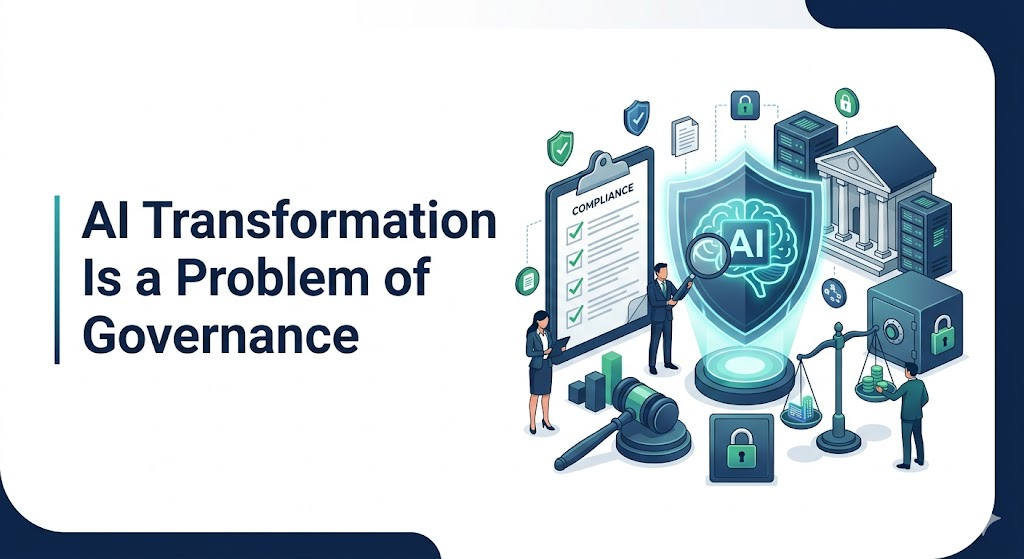

In the rapidly evolving landscape of 2026, organizations worldwide are pouring billions into artificial intelligence initiatives. Yet many ambitious AI projects stall or fail outright—not because the models lack power, but because the structures guiding their use are missing. This reality boils down to one clear insight: AI transformation is a problem of governance. Technology provides the tools, but without robust frameworks for accountability, risk management, and ethical oversight, even the most advanced systems create more problems than progress.
This comprehensive guide explores why governance has become the central bottleneck in AI transformation. Drawing on the latest 2025–2026 industry reports and regulatory developments, we examine the governance gaps holding companies back, the proven frameworks that drive success, and actionable steps any organization can take today. Whether you lead a startup, enterprise, or public institution, understanding that AI transformation is a problem of governance equips you to scale responsibly and capture real value.
The Shift from Tech Hype to Governance Reality
For years, conversations about AI centered on model size, training data, and computational breakthroughs. By 2026, that narrative has flipped. AI is now embedded in core workflows—from supply chain optimization to customer decision engines—yet scaling remains elusive. Industry analyses reveal that approximately 70% of enterprise AI projects fail not due to technological shortcomings, but because of governance gaps such as unclear accountability, inadequate oversight, and misaligned processes.
This pattern repeats across sectors. Teams deploy powerful tools without defined ownership or decision rights, leading to fragmented adoption, compliance blind spots, and unintended risks. The result? Wasted investment and lost competitive edge. Recognizing that AI transformation is a problem of governance shifts the focus from “which model is best” to “how do we control and direct it safely at scale?”
Why Governance Lags Behind AI Adoption
The pace of AI experimentation has outstripped the development of supporting structures. Surveys from 2025 show that 54% of organizations adopted AI technology too quickly and now face challenges in scaling it responsibly. Meanwhile, 74% of companies struggle to achieve and scale AI value despite high adoption rates, with 62% citing data governance as the greatest impediment.
Shadow AI—unauthorized use of generative tools—exacerbates the issue. Up to 37% of employees have used such tools without permission, while 34% of security leaders flag it as a top emerging threat. These unchecked deployments introduce data leaks, bias amplification, and compliance violations that no amount of raw computing power can fix. Governance, therefore, is not a checkbox; it is the operating system for sustainable AI transformation.
Regulatory Pressures Reshaping the Governance Landscape
Governments have responded to these gaps with landmark frameworks that underscore the governance imperative.
The EU AI Act: A Global Benchmark for Risk-Based Oversight
The European Union’s AI Act, the world’s first comprehensive AI regulation, classifies systems by risk level and imposes strict requirements on high-risk applications such as hiring tools and credit scoring. High-risk systems must undergo conformity assessments, ensure transparency, and maintain human oversight. By 2026, these rules are actively shaping global standards, compelling non-EU companies to align their practices if they wish to operate in the European market.
The Act’s extraterritorial reach demonstrates that governance is no longer optional—it is a market access requirement. Organizations ignoring this reality risk fines, reputational damage, and operational restrictions.
U.S. National Policy Framework: Moving Toward Unified Standards
In the United States, 2025–2026 executive actions have emphasized a national policy framework to reduce fragmented state-level rules. The December 2025 Executive Order and March 2026 legislative recommendations aim to preempt burdensome state laws while establishing consistent federal guidelines on accountability, data protection, and innovation-friendly governance.
This push for uniformity highlights a key truth: when governance remains patchwork, AI transformation slows. A coordinated national approach accelerates responsible deployment while protecting public trust.
Core Governance Challenges Blocking AI Transformation
Several interconnected issues illustrate why AI transformation is a problem of governance:
- Accountability and Decision Rights: Without clear owners for AI systems, responsibility diffuses. Boards often lack visibility into AI initiatives, leaving executives to experiment without strategic alignment.
- Data Quality and Lineage: AI outputs are only as reliable as their inputs. Poor data governance leads to biased or inaccurate results that can violate regulations or harm stakeholders.
- Risk Management at Scale: Agentic AI systems now perform multi-step tasks autonomously. Only 37% of organizations can enforce purpose limitations or deploy “kill switches” for misbehaving agents.
- Ethical and Bias Concerns: Unmonitored models can perpetuate discrimination, while deepfakes and misinformation rise as major threats—42% of leaders cite AI-generated disinformation as a top worry.
These challenges compound when governance is treated as an afterthought rather than a foundational capability.
The Business Case for Strong AI Governance
Organizations that invest in governance see outsized returns. Companies solving governance challenges deploy AI three times faster and achieve 60% higher success rates. Well-governed AI initiatives deliver measurable productivity gains, reduced compliance costs, and stronger stakeholder trust.
Beyond numbers, effective governance protects against litigation, insurance exclusions, and reputational harm. In 2026, carriers are hardening terms around AI-related liabilities, making robust oversight a competitive necessity rather than a cost center.
Building a Practical AI Governance Framework
Successful organizations treat governance as a living system, not static policy. Key components include:
- Cross-Functional Oversight: Establish an AI governance council with representatives from legal, IT, risk, ethics, and business units.
- Risk Classification and Tiered Controls: Mirror regulatory approaches by categorizing use cases and applying proportionate safeguards.
- Continuous Monitoring and Auditing: Deploy explainable AI tools and automated dashboards to track performance, drift, and compliance in real time.
- Employee Enablement: Provide clear usage guidelines and training to reduce shadow AI while encouraging innovation within boundaries.
- Incident Response Protocols: Define escalation paths and remediation steps before issues arise.
These elements turn governance from a barrier into an accelerator for AI transformation.
Industry Examples of Governance in Action
Manufacturing leaders use predictive maintenance governed by strict data lineage rules, cutting downtime while maintaining audit trails. Healthcare providers implement AI-assisted diagnostics under human-in-the-loop mandates, balancing efficiency with patient safety and regulatory compliance. Financial institutions leverage automated compliance checks within frameworks that ensure transparency and bias mitigation.
In each case, governance frameworks enabled safe scaling rather than constraining it.
Step-by-Step Roadmap to Address Governance Gaps
Ready to move forward? Follow this proven sequence:
- Conduct a governance maturity assessment across current AI initiatives.
- Define clear roles, responsibilities, and escalation protocols.
- Map high-risk use cases and prioritize controls.
- Integrate monitoring tools and reporting dashboards.
- Train teams and establish usage policies.
- Review and refine quarterly based on performance data and regulatory updates.
Starting small and iterating delivers quick wins while building long-term resilience.
Measuring Governance Effectiveness
Track leading indicators such as:
- Percentage of AI projects with assigned owners and documented controls
- Reduction in shadow AI incidents
- Audit pass rates and compliance readiness scores
- Time to detect and remediate model drift
- Employee confidence in safe AI usage
Regular measurement ensures governance evolves alongside technology.
Future Outlook: Governance as a Strategic Advantage
As AI agents become more autonomous and regulations mature, the organizations that master governance will lead. The gap between leaders and laggards will widen—not because of superior models, but because of superior oversight.
By 2026 and beyond, AI transformation is a problem of governance will remain the defining statement of the era. Those who solve it will unlock innovation at scale while minimizing downside risks.
Mastering AI Governance: The Strategic Imperative for Sustainable Transformation
AI transformation is a problem of governance, and the organizations that treat it as such are poised for lasting success. Technology will continue to advance at breakneck speed, but the real differentiator lies in the frameworks that guide its responsible use.
In 2026, strong governance is no longer a compliance exercise—it is a strategic capability that drives faster deployment, higher ROI, and greater trust. By closing governance gaps today, leaders ensure their AI initiatives deliver value without unintended consequences.
The path forward is clear: assess your current state, implement structured oversight, and treat governance as the foundation for every AI decision. The future belongs to those who govern AI transformation wisely, turning potential risks into proven advantages. Start building your governance edge now, and watch your organization thrive in the AI-powered economy ahead.
