

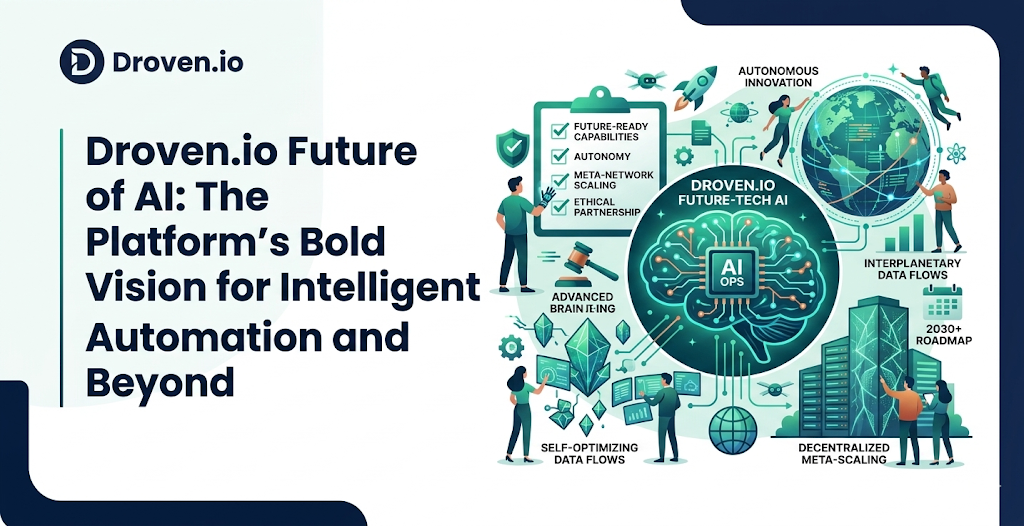

Droven.io has emerged as a trusted voice in technology insights, consistently delivering clear, actionable analysis on how artificial intelligence is reshaping everything from daily workflows to global industries. As we move through 2026, the platform’s coverage highlights a decisive shift: AI is no longer experimental — it has become the core engine of intelligent automation and digital transformation.
Droven.io emphasizes practical adoption over hype, focusing on systems that learn, adapt, and act autonomously while keeping humans firmly in the loop. This forward-looking perspective draws from real-time industry data, emerging tools, and proven case studies to paint a realistic roadmap for the years ahead.
Whether you run a startup, lead an enterprise team, or simply want to stay ahead of the curve, Droven.io’s insights on the future of AI offer a grounded, optimistic framework for navigating rapid change. This article distills the platform’s key predictions, trends, and strategies into one comprehensive guide.
Decoding Droven.io’s Core Vision for AI Evolution
Droven.io frames the future of AI as an integrated ecosystem built on three foundational pillars: data intelligence, machine learning models, and a dynamic automation layer. These elements work together to create self-improving systems that go far beyond simple rule-based tasks.
Data intelligence gathers and interprets massive streams of information from user behavior, logs, and external sources. Machine learning then uncovers hidden patterns and makes accurate predictions. Finally, the automation layer turns those insights into real-time actions — scheduling, responding, optimizing — with minimal human input.
This holistic approach, according to Droven.io, is what separates today’s static software from tomorrow’s truly intelligent platforms. By 2026, such systems are expected to power everything from predictive analytics in finance to real-time diagnostics in healthcare.
The Nine AI Trends Every Leader Must Track in 2026
Droven.io highlights nine practical trends that will separate winners from laggards this year. These are not futuristic concepts — they are already delivering measurable results for early adopters.
Agentic Workflows
Autonomous AI agents now manage multi-step processes end-to-end. Sales outreach, inventory reordering, and compliance checks happen without constant supervision, slashing cycle times and reducing errors.
AI Co-Workers
Specialized copilots embedded in HR, finance, and marketing teams handle routine analysis and content generation. They augment human output rather than replace it, leading to faster, more consistent results.
Smaller, Specialized Models
Compact models tailored for specific tasks are cheaper to run and easier to deploy than massive general-purpose systems. They shine in edge computing and custom enterprise use cases.
Data Ownership Becomes a Competitive Edge
Organizations are moving away from public datasets toward proprietary, high-quality internal data. This shift creates sharper insights and more personalized customer experiences.
Real-Time AI Decision Making
Batch processing is giving way to instant responses in fraud detection, personalized recommendations, and supply-chain adjustments. Low-latency infrastructure is now table stakes.
Stricter AI Regulation and Governance
Global frameworks are tightening around bias, transparency, and accountability. Compliant organizations build greater customer trust and avoid costly penalties.
Multimodal AI Systems
Models that seamlessly process text, images, video, and audio enable richer interactions — from advanced customer support to immersive marketing campaigns.
Vertical AI Solutions
Industry-specific tools in healthcare, legal, and finance deliver higher accuracy and faster ROI because they are trained on domain-specific data.
Building Human-AI Trust
Explainability and reliability are now non-negotiable. Leaders who invest in transparent systems see higher adoption rates and stronger internal buy-in.
These trends, Droven.io notes, are already influencing budgeting decisions and hiring priorities across sectors.
How Intelligent Automation Is Reshaping Daily Operations
Droven.io stresses that intelligent automation represents the next evolution beyond robotic process automation (RPA). Modern systems don’t just follow scripts — they learn, adapt, and optimize themselves in real time.
In business automation, this means fewer hours spent on data entry, email triage, and routine reporting. Healthcare benefits from earlier disease detection and personalized treatment plans. Finance gains real-time fraud monitoring and smarter risk assessment. Cybersecurity teams receive instant threat alerts based on evolving attack patterns.
The platform points out that these capabilities stem from breakthroughs in deep learning, natural language processing, cloud computing, and big data analytics — all working in concert.
Industry-Specific Transformations Already Underway
Droven.io’s analysis shows AI adoption rates accelerating dramatically. By 2025–2026, roughly 60% of businesses have integrated AI tools, with the global market projected to surpass $500 billion by 2030.
- Healthcare: AI assists with 70% of diagnostic processes in leading institutions, speeding up image analysis and treatment planning.
- Finance: Up to 80% of routine operations can now be automated, from transaction monitoring to personalized investment advice.
- Education: Personalized learning paths adapt to individual student needs, improving outcomes by as much as 50% in pilot programs.
- Retail and Marketing: Predictive systems drive 25% sales lifts through hyper-personalized recommendations.
These numbers underscore Droven.io’s central message: AI is delivering tangible ROI today, not just promising it for tomorrow.
Quantifiable Benefits Driving Widespread Adoption
Early results shared in Droven.io coverage are compelling. Organizations report 30–50% productivity gains in automated workflows. Operational costs drop as manual tasks shrink. Decision-making speeds up with data-driven insights arriving in real time. Scalability improves dramatically because AI systems grow with demand rather than requiring proportional staff increases.
One retail example cited across analyses shows a company recovering 8–10 hours per employee weekly through smart automation — time now redirected toward creative strategy and customer relationships.
Navigating the Real Risks and Ethical Challenges
Droven.io maintains a balanced view, openly discussing potential downsides. Data privacy remains a top concern as systems ingest ever-larger datasets. Algorithmic bias can produce unfair outcomes if training data is incomplete or skewed. Job displacement estimates reach 40% for certain repetitive roles, though new opportunities in AI oversight and ethics continue to emerge.
High implementation costs can challenge smaller organizations, and over-reliance on automation risks reducing human creativity if not managed thoughtfully. The platform urges proactive governance, continuous employee reskilling, and transparent design to mitigate these issues.
Long-Term Predictions: AI from 2026 to 2035
Looking further ahead, Droven.io envisions AI becoming deeply embedded in daily life by 2030. Autonomous agents will handle complex projects independently. Self-learning systems will require far less retraining. Human-AI collaboration will reach new heights, with AI acting as a true creative partner rather than a tool.
By 2035, the platform predicts widespread human-AI integration across economies, driving innovation while raising fresh questions about regulation, ethics, and societal equity. The key differentiator for success will be adaptability and ethical stewardship.
Practical Steps to Prepare Your Organization Today
Droven.io offers clear guidance for leaders:
- Start with high-impact, low-complexity use cases to build momentum and gather internal data.
- Prioritize proprietary datasets and invest in clean, well-governed information architecture.
- Focus on explainable AI solutions that teams can understand and trust.
- Build cross-functional teams that combine domain expertise with AI literacy.
- Schedule regular audits of automated systems for bias, performance, and compliance.
Early movers who treat AI as a strategic capability rather than a cost center will gain lasting advantages.
Essential Skills for the AI-Driven Workplace of Tomorrow
Droven.io repeatedly stresses the human element. Critical skills include AI literacy, data analysis, critical thinking, adaptability, and creative problem-solving. Technical roles will evolve toward oversight, ethics, and system design, while non-technical professionals will need to collaborate effectively with intelligent tools.
Embracing the Droven.io Vision: AI as a Strategic Partner
Droven.io’s perspective on the future of AI is both exciting and pragmatic. By focusing on intelligent automation, real-world applications, and responsible innovation, the platform equips readers to move beyond experimentation and into sustained competitive advantage.
The coming decade will reward organizations that treat AI as a collaborative partner rather than a replacement technology. Those who invest in the right trends, build trustworthy systems, and prepare their teams will thrive in an era where intelligence is embedded everywhere.
The message from Droven.io is clear: the future of AI belongs to those who understand it today and act on it decisively. Start exploring these trends now — your next strategic advantage may already be running quietly in the background.
FAQ
What does Droven.io say about the future of AI?
Droven.io views the future as one of practical, intelligent automation powered by data, machine learning, and adaptive systems that augment human capabilities.
Which AI trends should businesses prioritize in 2026?
The platform highlights agentic workflows, smaller specialized models, real-time AI, multimodal systems, and vertical industry solutions as immediate opportunities.
Will AI replace jobs according to Droven.io?
No. While some roles will change, the emphasis is on human-AI collaboration that creates new opportunities and shifts focus to higher-value work.
How big will the AI market grow by 2030?
Projections cited in Droven.io coverage point to a global market exceeding $500 billion, with strong enterprise adoption.
What are the biggest risks in AI adoption?
Key concerns include data privacy, algorithmic bias, implementation costs, and ethical governance — all of which Droven.io recommends addressing proactively.
